
More reaches the balance
After estimated interest, the larger payment leaves more money to reduce principal in the model.

Credit card payment guide
Paying above the required minimum can reduce principal sooner. See how an extra $100 each month changes payoff time, interest, and the balance in a transparent credit card example.
Published and last reviewed September 18, 2026
Compare your extra paymentAfter estimated interest, the larger payment leaves more money to reduce principal in the model.
A smaller remaining balance can generate less interest in later periods when the APR and other assumptions stay equal.
The calculator compares scenarios. It does not decide what payment is affordable or appropriate for your budget.
Both scenarios start with a $5,000 balance, 24% APR, and a planned $150 monthly payment. The second scenario adds $100 each month while a balance remains. Under this model, the larger payment reaches payoff 2 years 6 months sooner and reduces estimated interest by $1,872.80.
Estimated first-month interest is $100 in both scenarios. The $150 payment reduces principal by $50, while the $250 payment reduces it by $150. That $100 difference lowers the balance used in the next modeled month.
The model never pays more than the remaining balance plus estimated interest. The accelerated plan contributes $2,549.37 above the original payment schedule because its final payment is smaller than $250.
Pay at least the minimum shown on the latest statement by its due date. A planned extra amount does not replace the required payment, and the next statement can change.
Read CFPB credit card guidanceWhen a US credit card carries balances at different APRs, the amount above the minimum is generally applied to the highest-APR balance first. Special rules and exceptions can apply, including deferred-interest plans.
Review payment allocation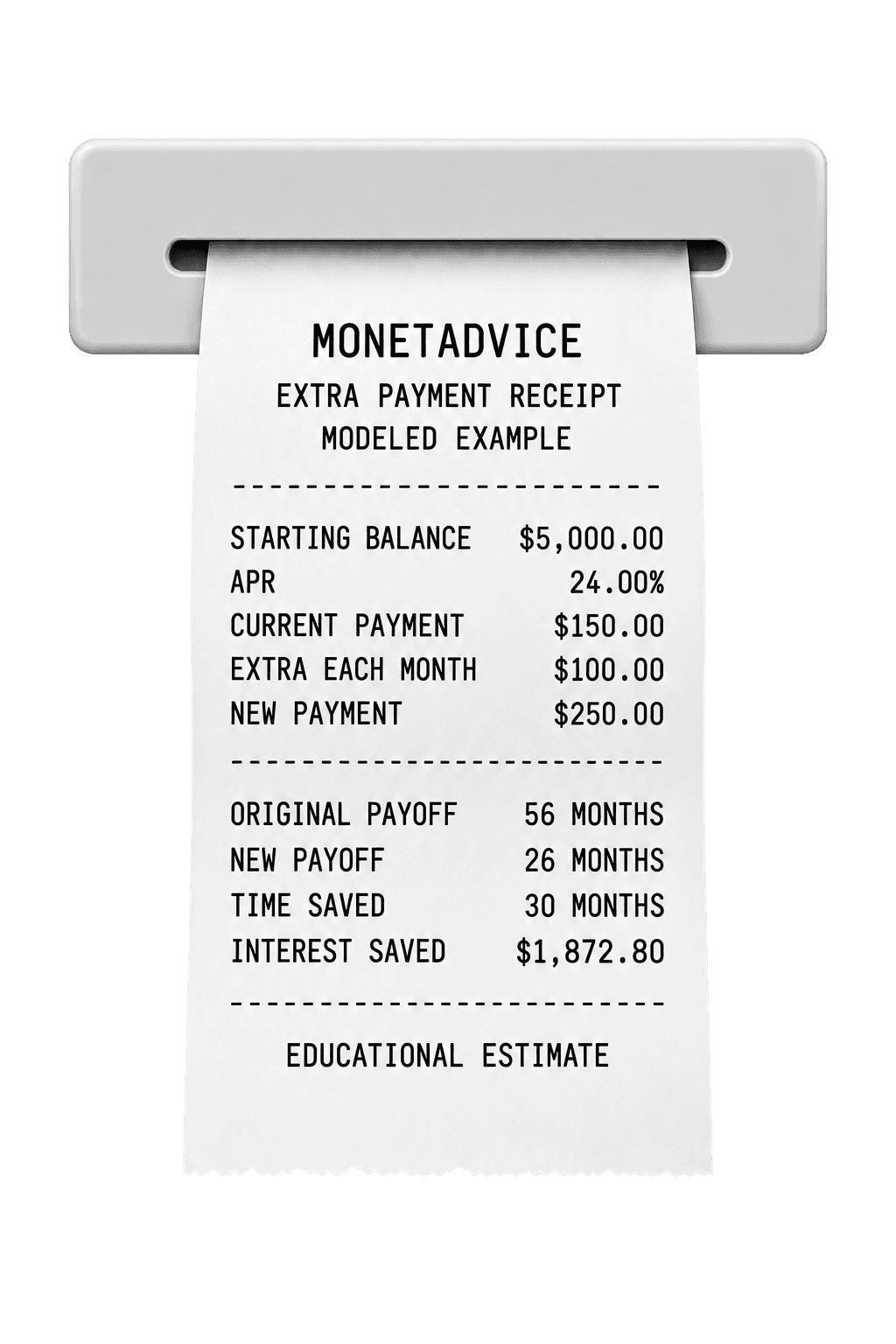
Use the current balance, APR information, required minimum, and due date. Check for balances with different rates or promotional terms.
Compare several extra amounts instead of treating $100 as a recommendation. Keep required payments and essential expenses in the plan.
Use the same starting balance, APR, payment timing, and new-purchase assumptions so the extra amount is the main variable.
Run the estimate again after a new purchase, fee, APR change, missed payment, or material change in what you can pay.
The example estimates monthly interest as opening balance multiplied by APR divided by 12, then applies one monthly payment. It assumes a fixed APR, no fees, no new purchases, no missed payments, and one balance with one rate.
Actual issuers may calculate interest daily, use multiple APRs, apply payments under account-specific rules, and change rates or fees. The results are an educational comparison, not a payoff quote or a recommendation to pay a particular amount.
If you cannot make the required minimum, contact the issuer promptly. The CFPB also describes options for contacting a card company and finding credit counseling help.
Read CFPB payment-help guidanceThe amount above your required minimum can reduce the balance faster. Under otherwise equal assumptions, a lower balance can produce less future interest and an earlier payoff date. Your actual result depends on payment timing, issuer allocation, APRs, fees, and new transactions.
There is no universal amount. Start with the minimum shown on your statement, protect essential expenses, and compare additional amounts that fit your budget. The calculator shows estimated time and interest differences without recommending a personal payment.
Yes. You may generally pay part or all of the account balance at any time. Continue checking each statement because the minimum due, due date, APR, fees, and account terms can change.
It can. Many issuers calculate interest daily, so reducing a balance earlier can reduce later interest. The amount saved depends on the balance, APR, payment date, allocation rules, and whether new charges are added.
Not as a separate principal-only instruction. For US credit cards with balances at different APRs, federal rules generally require the amount above the minimum to be allocated first to the balance with the highest APR, subject to special rules and exceptions. The issuer controls how the required minimum portion is allocated.
No. The $100 amount in this guide is an illustration. A useful payment plan must still leave room for essential expenses and every required payment. If you cannot make the minimum, contact the issuer promptly rather than relying on a payoff comparison.
Continue with another explanation, worked example, or debt-planning comparison.
U.S. debt and interest rates
Understand why Treasury yields move, how federal borrowing fits in, and what higher yields can mean for mortgages, savings, and bonds.
Read the Treasury yield guideCredit card payments
Compare a declining credit card minimum with a fixed payment using the same starting balance, APR, and first payment.
Read the payment guideDebt payoff strategies
Compare Snowball and Avalanche with a worked example, research context, practical tradeoffs, and a decision checklist.
Read the strategy guideEnter your balance, APR, current payment, and an additional monthly amount. The calculator compares both plans through the same payoff engine used for this example.
Want to compare a changing statement minimum with a steady payment first? Read the Minimum Payment vs Fixed Payment guide.

