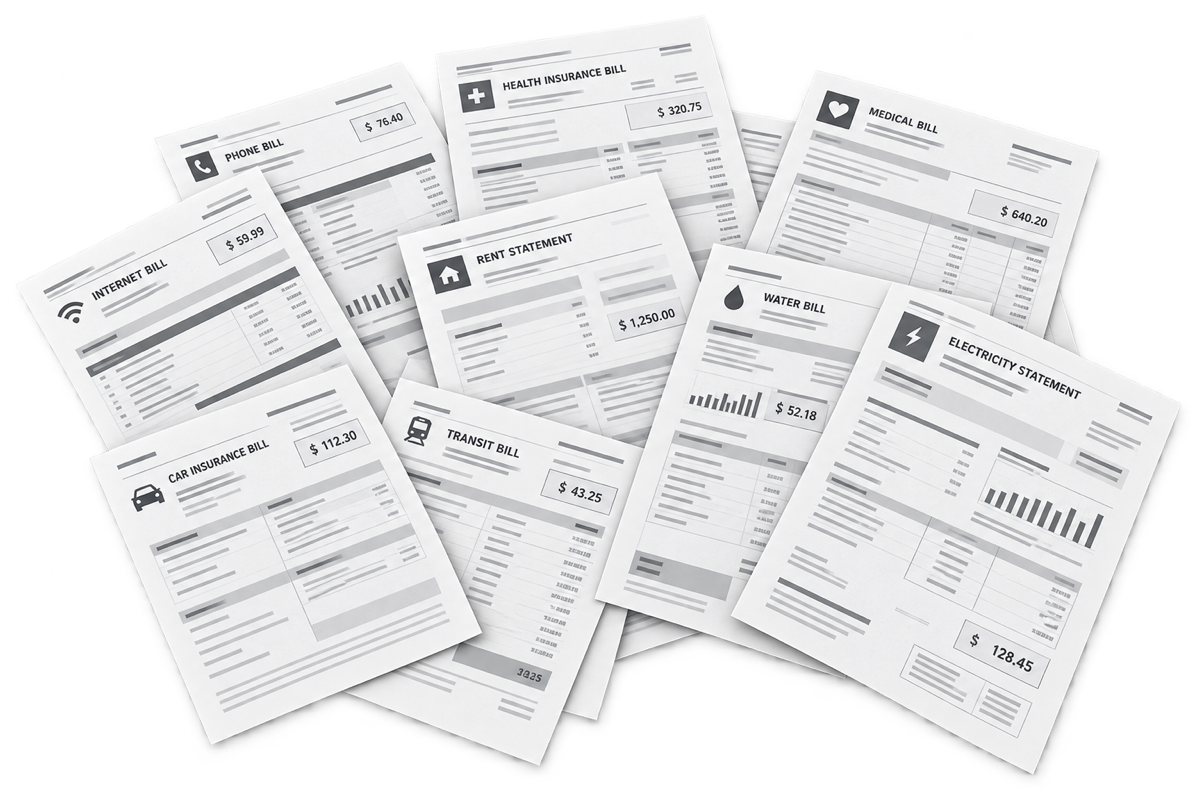
Count essential expenses
Base the target on costs you need to keep paying, rather than automatically multiplying your salary.

Emergency savings guide
Start with the bills you would still need to pay if income stopped. Compare the cushion three or six months would provide, then turn that target into a realistic savings timeline.
By MonetAdvice. Last reviewed November 4, 2026.
Calculate your emergency fundFree planning worksheet
List essential monthly bills, compare 3- and 6-month reserves, and estimate the remaining gap. The spreadsheet includes editable example values and formulas. The PDF is designed for printing and manual calculations.
Free to download. No email or sign-up required. Files do not send the amounts you enter back to MonetAdvice.
Base the target on costs you need to keep paying, rather than automatically multiplying your salary.
Three and six months are useful scenarios. The time needed to replace income and the obligations you support can justify a larger cushion.
A target can be large without being an all-or-nothing goal. A smaller reserve already gives you more cash to meet an unexpected bill.
General education and illustrative scenarios, not a personal savings recommendation or a guarantee against financial hardship.
Fidelity describes a three-to-six-month range with household circumstances in mind. FDIC guidance discusses at least six months. The CFPB emphasizes that the amount depends on your situation. These are planning reference points, not a universal rule.
A smaller cushion
A shorter income gap may be more manageable when essential costs are flexible, income sources are dependable and there is realistic support available. Check whether two household incomes could be disrupted together.
Three months can also be an intermediate milestone while you continue building a larger reserve.
More time to recover
A longer job search, variable earnings, a single household income or dependents can make a larger cushion useful. Include essential costs that an employer currently covers if you would need to pay them yourself.
Six months is not a ceiling or a guarantee. Larger shocks, insurance gaps and longer interruptions may require a different target.
Same expenses, two targets
With $1,500 already saved and $500 added each month, the larger reserve takes longer to build. Both scenarios use 0% APY so the comparison shows contributions alone.
$9,000
$18,000
The six-month target is twice as large, but here it takes 33 monthly contributions rather than 15 because the same $1,500 starting savings is available in both scenarios. Do not add the targets together: $18,000 is the total six-month reserve.
Compare your own targetsUse the spending you would need to maintain during an interruption. Review recent bills, account for seasonal costs and count each obligation once.
Rent or mortgage payments and required housing costs. Avoid counting insurance or taxes again if they are already included in a mortgage payment.
Electricity, water, heating, and basic phone or internet service that you would need to maintain.
Groceries and other basic household food costs. Separate these from optional dining and entertainment spending.
Required commuting, fuel, transit, and essential vehicle costs. Review which expenses could change during a job search.
Insurance, minimum debt payments, essential healthcare, and necessary childcare or dependent care.
Subscriptions, travel, gifts, and extra debt repayments can be considered separately unless you intentionally want the reserve to cover them.
Keep predictable annual bills in a separate savings bucket or include a monthly allowance. Do not count the same cost or reserved cash twice.
Review the plan when income, dependents or essential bills change. If you use the reserve, revise the remaining gap and rebuild as cash flow allows.
Step 1
Add the monthly bills your reserve needs to cover.
Step 2
Multiply the same expenses by three and six.
Step 3
Subtract available emergency savings and choose an affordable monthly amount.
Vanguard distinguishes unexpected spending from a longer income interruption. One repair bill and several months without pay are different problems. A practical plan can start with a smaller cash buffer and build toward the larger expense-based target.
Read Vanguard's explanationMoney set aside for emergencies needs to be accessible when the bill arrives. Consider withdrawal restrictions, penalties and the risk of a loss alongside any advertised yield. A credit limit is borrowed money, not savings already available to spend.
The CFPB discusses keeping emergency money safe and accessible. If choosing an account, verify the institution, insurance eligibility and account terms directly.
The worked example uses the same engine as our Emergency Fund Calculator: target = essential monthly expenses x months of coverage. Remaining gap = target minus current emergency savings, floored at zero. Contributions occur monthly; the fixed editorial start date is October 1, 2026.
At 0% APY, the funding time is the remaining gap divided by the monthly contribution, rounded up. The example assumes no withdrawals, fees, taxes, inflation or changes in costs and income. It does not estimate the probability of job loss or decide how much protection your household needs.
For a different contribution frequency or a deadline, use the Savings Goal Calculator. For the full calculation conventions, read our Methodology.
Three months is a planning target, not a guarantee. Income stability, time needed to replace lost income, dependents, insurance and unavoidable bills all matter. Compare three and six months of your own essential expenses before deciding what buffer to work toward.
Multiply essential monthly expenses by six. With $3,000 of essential costs per month, the target is $18,000. Savings already reserved for emergencies reduce the amount still to save, not the target itself.
An expense-based target estimates the bills your reserve would need to cover during an income interruption. Gross income can include taxes and money you normally save or spend optionally, so multiplying income can produce a very different target. Account for costs that could change if you lose employer benefits.
Include housing, basic utilities, groceries, necessary transportation, insurance, essential healthcare, dependent care and required minimum debt payments. Count each bill once. Planned annual bills can be budgeted separately or converted to monthly amounts, but do not fund the same cost twice.
At 0% APY, subtract current emergency savings from the target, divide the remaining gap by the monthly contribution and round up to a whole month. For a $9,000 target, $1,500 already saved and $500 added monthly, the example takes 15 monthly contributions. Withdrawals or changing contributions change that timeline.
Required minimum payments remain part of your essential budget. Extra repayment and emergency saving compete for available cash. Compare interest costs, access to cash and the risk of needing to borrow again; neither calculator determines the right allocation for your household.
Reviewed by MonetAdvice on November 4, 2026. An independent credentialed review of this guide has not been published. The worked example is our calculation, not a result supplied or endorsed by these organizations.
Read our Editorial Policy or report a correction.
Compare expense-based targets and the time needed to fund them.
Open calculatorExplore a target date or contributions that fit your saving schedule.
Open calculatorContinue with another explanation, worked example, or savings and debt comparison.
U.S. debt and interest rates
Understand why Treasury yields move, how federal borrowing fits in, and what higher yields can mean for mortgages, savings, and bonds.
Read the Treasury yield guideCredit card payments
See how paying more than the minimum changes principal, payoff time, and modeled interest in a transparent $100 example.
Read the extra-payment guideCredit card payments
Compare a declining credit card minimum with a fixed payment using the same starting balance, APR, and first payment.
Read the payment guide